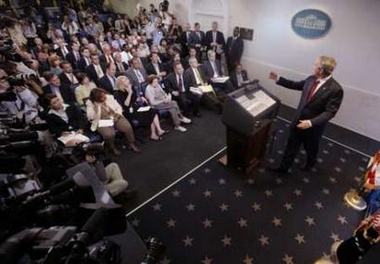
President Bush speaks at a press conference in the Brady Press Briefing Room at the White House, July 12, 2007.
Picture:Jason Reed/Reuters
History fairer to Bush
The Australian
Andrew Roberts
January 20, 2009
THE American lady who called to see if I would appear on her radio program was specific. "We're setting up a debate," she said sweetly, "and we want to know from your perspective as a historian whether George W. Bush was the worst president of the past century, or might he be the worst president in American history?"
"I think he's a good president," I told her, which seemed to dumbfound her and wreck my chances of appearing on her show.
In the avalanche of abuse and ridicule that we are witnessing in the media assessments of Bush's legacy, there are factors that need to be borne in mind if we are to come to a judgment that is not warped by the kind of partisan hysteria that has characterised this issue on both sides of the Atlantic.
The first is that history, by looking at the key facts rather than being distracted by the loud ambient noise of the 24-hour news cycle, will probably hand down a far more positive judgment on Bush's presidency than the immediate, knee-jerk loathing of the American and European elites.
At the time of September 11, which will forever rightly be regarded as the defining moment of the presidency, history will look in vain for anyone predicting that the Americans murdered that day would be the last ones to die at the hands of Islamic fundamentalist terrorists in the US from that day to this.
The decisions taken by Bush in the immediate aftermath of that ghastly moment will be pored over by historians for the rest of our lifetimes. One thing they will doubtless conclude is that the measures he took to lock down America's borders, scrutinise travellers to and from the US, eavesdrop on terrorist suspects, work closely with international intelligence agencies and take the war to the enemy has foiled dozens, perhaps scores, of would-be murderous attacks on America. There are Americans alive today who would not be but for the passage of the Patriot Act. There are 3000 people who would have died in the August 2005 airliner conspiracy if it had not been for the superb inter-agency co-operation demanded by Bush after September 11.
The next factor that will be seen in its proper historical context in years to come will be the true reasons for invading Afghanistan in October 2001 and Iraq in April 2003.
The conspiracy theories believed by many (generally, but not always) stupid people - that it was "all about oil", or the securing of contracts for the US-based Halliburton corporation, and so on - will slip into the obscurity from which they should never have emerged had it not been for comedian filmmakers such as Michael Moore.
Instead, the obvious fact that there was a good case for invading Iraq based on 14 spurned UN resolutions, massive human rights abuses and unfinished business following the interrupted invasion of 1991 will be recalled.
Similarly, the cold light of history will absolve Bush of the worst conspiracy theory accusation: that he knew there were no weapons of mass destruction in Iraq. History will show that, in common with the rest of his administration, the British government, Saddam Hussein's own generals, the French, Chinese, Israeli and Russian intelligence agencies, and of course the Secret Intelligence Service and the CIA, everyone assumed that a murderous dictator does not voluntarily destroy the WMD arsenal he has used against his own people. And if he does, he does not then expel the UN weapons inspectorate looking for proof of it, as he did in 1998 and again in 2001.
Bush assumed that the coalition forces would find mass graves, torture chambers, evidence for the gross abuse of the UN's food-for-oil program, but also WMDs. He was right about each but the last, and history will place him in the mainstream of Western, Eastern and Arab thinking on the matter.
History will probably, assuming it is researched and written objectively, congratulate Bush on the fact that whereas in 2000 Libya was an active and vicious member of what he was accurately to describe as an "axis of evil" of rogue states willing to employ terrorism to gain its ends, four years later Muammar Gaddafi's WMD program was sitting behind glass in a museum in Oakridge, Tennessee. With his characteristic openness and at times almost self-defeating honesty, Bush has been the first to acknowledge his mistakes - for example, tardiness over Hurricane Katrina - but there are some he made not because he was a ranting right-winger, but because he was too keen to win bipartisan support.
The invasion of Iraq should probably have taken place months earlier, but was held up by the attempt to find support from UN Security Council members, such as Jacques Chirac's France, that had ties to Iraq and hostility towards the Anglo-Americans.
History will also take Bush's verbal fumbling into account, reminding us that Ronald Reagan also misspoke regularly, but was still a fine president. The first MBA president, who had a higher grade-point average at Yale than John Kerry, Bush's supposed lack of intellect will be seen to be a myth once the papers in his presidential library in the Southern Methodist University in Dallas are available.
Films such as Oliver Stone's W, which portray him as a spitting, oafish frat boy who eats with his mouth open and is rude to servants, will be revealed by the diaries and correspondence of those around him to be absurd travesties of this charming, interesting, beautifully mannered history buff who, were he not the most powerful man in the world, would be a fine person to have as a pal. Mind you, not everyone's pal :-) - Steve
Instead of Al Franken, history will listen to Bob Geldof praising Bush's efforts over AIDS and malaria in Africa; or to Manmohan Singh, the Prime Minister of India, who told him last week: "The people of India deeply love you." And certainly to the women of Afghanistan thanking him for saving them from Taliban abuse, degradation and tyranny.
When Abu Ghraib is mentioned, history will remind us that it was the Bush administration that imprisoned those responsible for the horrors. When water-boarding is brought up, we will see that it was used on only three suspects, one of whom was Khalid Sheikh Mohammed, al-Qa'ida's chief of operational planning, who divulged vast amounts of information that saved hundreds of innocent lives. When extraordinary renditions are queried, historians will ask how else the world's most dangerous terrorists should have been transported. On scheduled flights?
The credit crunch, brought on by the Democrats in Congress insisting on home ownership for non-creditworthy people, will initially be blamed on Bush, but the perspective of time will show that the problems at Fannie Mae and Freddie Mac started with the deregulation of the Clinton era. Instead, Bush's very un-ideological but vast rescue package of $US700 billion ($1 trillion) might well be seen as lessening the impact of the squeeze and putting America in position to be the first country out of recession, helped along by his huge tax-cut packages since 2000.
Sneered at for being simplistic in his reaction to September 11, Bush's visceral responses to the attacks of a fascistic, totalitarian death cult will be seen as having been substantially the right ones.
Mistakes are made in every war, but when virtually the entire military, diplomatic and political establishment in the West opposed it, Bush insisted on the surge in Iraq that has been seen to have brought the war around, and set Iraq on the right path. Today its gross domestic product is 30 per cent higher than under Saddam, and it is free of a brutal dictator and his rapist sons.
The number of US troops killed during the eight years of the war against terror has been fewer than those slain capturing two islands in World War II, and Britain has lost fewer soldiers than on a normal weekend on the Western Front. As for civilians, there have been fewer Iraqis killed since the invasion than in 20 conflicts since World War II.
Iraq has been a victory for the US-led coalition, a fact that the Bush-haters will have to deal with when perspective finally, perhaps years from now, lends objectivity to this fine man's record.
Andrew Roberts's Masters and Commanders: How Roosevelt, Churchill, Marshall and Alanbrooke Won the War in the West is published by Penguin.
The US waits to see who will blink first in deciding the future of US involvement in Iraq,
writes Washington correspondent Geoff Elliott, in an extract from Weekend Australian, July 14 2007
IN a bubble. In denial. The worst US president in history. Or maybe he is right: we're in the fight of our lives. It's history's call. But watching George W. Bush at the lectern yesterday at the White House, one thing is clear: he's staying the course. He has little choice.
The week in Washington may have opened with more nervous Republicans in Congress bolting from the President's Iraq war policy but it ended in familiar fashion: Bush defending his decision to keep more than 160,000 troops in Iraq.
Bush was in full Churchillian mode yesterday. The President is known to compare the fight he is leading with the kind Winston Churchill waged against Adolf Hitler. He keeps a bust of Churchill in the Oval Office. In front of the press corps he steadfastly defended his administration's policy in Iraq. "I believe we can succeed in Iraq, and I know we must," Bush said. "When we start drawing down our forces in Iraq, it will be because our military commanders say the conditions on the ground are right, not because pollsters say it'll be good politics." Iraq can, and must be, won. There's no surrender to the enemy, which in Bush's mind is not only insurgents and al-Qa'ida in Iraq but also, it seems, the US Congress.
"I don't think Congress ought to be running the war," Bush said yesterday, with a pointed finger regularly jabbing the lectern. "Trying to run a war through resolution is a prescription for failure, as far as I'm concerned, and we can't afford to fail. Congress has got all the right to appropriate money, but the idea of telling our military how to conduct operations, for example, or how to, you know, deal with troop strength, I don't think it makes sense, I don't think it makes sense today, nor do I think it's a good precedent for the future."
WOULD a Barack Obama ascendancy in the US presidential election lead to a new war in the Middle East? There's quite a respectable case for thinking it might. Would it also lead to catastrophe in Iraq?
There is something a little weird about the Obama phenomenon. It's a bit like the Princess Di obsession. His is a candidacy of celebrity and identity. But we live in a world of celebrity and identity, and for a time the world probably would fall in love with president Obama.
At a deeper level, Obama's soaring rhetoric seems to serve no purpose beyond itself. Abraham Lincoln and Franklin Roosevelt used magnificent speeches to argue specific causes: ending slavery, defeating Nazism. Obama's cadences are superbly non-specific: "Yes, we can!"
Nonetheless, Obama does have a record and it places him generally on the Left of the Democratic Party, although he has often used centrist and sometimes even hawkish rhetoric. But his closest advisers all come from the Left of the party.
Iraq has faded as an issue because the US strategy there is now working. There is a real chance the US could prevail in Iraq. This is what Clinton was worried about when she earlier hedged her bets on Iraq. But Obama, playing not least for the Hollywood Bush haters, has left little room to manoeuvre as president on Iraq. A sudden US withdrawal from Iraq could be catastrophic for the Middle East, and for US standing generally. Obama is all over the place on foreign policy. He has threatened to bomb Pakistan to kill terrorists (imagine if Bush or McCain had said such a thing) but also to journey to Tehran to fix a grand bargain with Mahmoud Ahmadinejad. His rhetoric on foreign policy, apart from Iraq, is scattered, which is a sure sign that he's never given the matter any serious thought.
So why do I think an Obama ascendancy could cause war in the Middle East? It's a simple calculation. Despite the recently released US National Intelligence Estimate that Iran is not working on nuclear weaponisation, no one seriously doubts that Iran is moving towards nuclear weapons. The NIE confirms it is continuing to pursue uranium enrichment and missile capabilities. Weaponisation is the easiest bit of the process.
Many Israeli leaders say that a nuclear armed Iran represents an existential threat to Israel. If they really believe this, they have no alternative but to strike Iran's nuclear facilities. If they believe McCain will win, they will have faith that the Americans, one way or another, will try to handle the Iranians. If they believe Obama will win, they not only believe he definitely won't handle Iran effectively, but he might even stop them from doing so.
The same calculations in a way apply to the Bush administration people. Almost no one in the Bush administration favoured the troop surge in Iraq except Bush himself. Yet he went ahead and did it, and it worked.
One of Bush's greatest criticisms of Bill Clinton is that he didn't confront problems but kicked them down the road and left them for his successor. If Bush believes Iran will go nuclear, he might have faith that McCain could handle it. He will have absolutely no faith that Obama would handle it.
The odds are against a US strike on Iran under any circumstances, and I would say the odds are even against an Israeli strike. But either or both are much more likely if it looks like Obama will win.
End of article