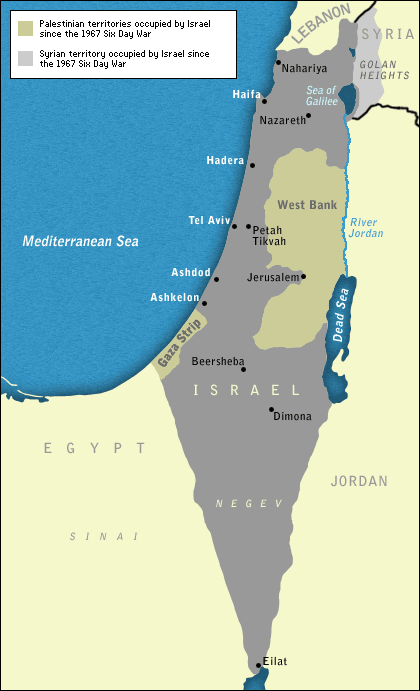
| Distances: | Tel Aviv to Jerusalem 63 kms Tel Aviv to Haifa 95 kms |
Publisher: Routledge (Taylor & Francis), 2002;
ISBN: 0415281172 (paperback),
0415281164 (hardback); Map: NPR Online
Click here for prior news from November 27th, 2009
|
| ||
Publisher: Routledge (Taylor & Francis), 2002; ISBN: 0415281172 (paperback), 0415281164 (hardback); Map: NPR Online
|
Barack Obama's stand puts Mid-East in danger
Weekend Australian
Yossi Klein Halevi, Jerusalem
Saturday, March 20, 2010
Yossi Klein Halevi is a senior fellow of the Shalem Centre in Jerusalem, and a contributing editor of The New Republic
SUDDENLY my city feels like a war zone again. Since the bomb attacks ended in 2005, life in Jerusalem has been relatively calm. The worst disruption has been the traffic jams from construction of a light rail, just like in a normal city. But now there are groups of helmeted border police near the gates of the Old City, smoke from burning tyres in the Arab area outside my porch, young men marching with green Islamic flags toward my neighbourhood, and ambulances parked ready for the city's ultimate nightmare.
The return of menace to Jerusalem is not because an Israeli bureaucrat announced stage four of a seven-stage process in the construction of 1600 extra apartments in Ramat Shlomo, a Jewish neighbourhood in northeast Jerusalem. Such announcements and building of Jewish projects have become so routine over the years that Palestinians have scarcely responded, let alone violently.
In negotiations between the Palestinians and Israel, the permanence of Ramat Shlomo and other Jewish neighbourhoods in East Jerusalem, has been a given. Ramat Shlomo, between the Jewish neighbourhoods of French Hill and Ramot, will remain within the boundaries of Israeli Jerusalem, according to every peace plan. Unlike the small Jewish enclaves inserted into Arab neighbourhoods, on which Israelis are strongly divided, building more housing in Jewish areas of East Jerusalem defines the national consensus.
So why the outbreak of violence now ' Why Hamas's Day of Rage over Jerusalem, and the Palestinian Authority's call to gather on the Temple Mount to save the Dome of the Rock from non-existent plans to build the Third Temple ' Why the outrage over rebuilding a synagogue, which was destroyed by the Jordanians in the 1948 war, in the Old City's Jewish quarter, when dozens of synagogues and yeshivas were built without incident '
The answer lies not in Jerusalem but in Washington. By placing the issue of building more Jewish housing in East Jerusalem at the centre of the peace process, US President Barack Obama has inadvertently challenged the Palestinians to do no less.
Astonishingly, Obama is repeating the key tactical mistake of his failed efforts to restart the Middle East peace talks over the past year. Although Obama's insistence on a freeze on Jewish settlements to help restart negotiations was legitimate, he went a step too far by including building in East Jerusalem. Every Israeli government over the past four decades has built in the Jewish neighbourhoods of East Jerusalem, and no Israeli government, let alone one headed by the Likud party, could possibly agree to a freeze.
Obama made the resumption of negotiations hostage to a demand that could not be met. As a result, Palestinian leaders were forced to adjust their demands. Obama is responsible for one of the most absurd turns in the history of the Middle East peace negotiations. Although Palestinian leaders negotiated with Israeli governments that built Jewish settlements in the West Bank, they now refuse to sit down with the first Israeli government to agree to a suspension of building. Obama's demand for a freeze on Israeli building in Jerusalem led to a freeze in negotiations.
Finally, after intense efforts, the Obama administration produced the pathetic achievement of "proximity talks", setting Palestinian-Israeli negotiations back a generation to the time when Palestinian leaders refused to sit with the Israelis.
That Obama could be guilty of such amateurishness was perhaps forgivable because he was an amateur. But he has now taken his failed policy and intensified it. By demanding that Israel stop building more Jewish housing in Ramat Shlomo and elsewhere in East Jerusalem - and placing that demand at the centre of US-Israeli relations - he is ensured the Palestinians won't show up, even to proximity talks. This is no longer amateurishness; it is pique disguised as policy.
When the announcement about building in Ramat Shlomo was made, Israelis shared US Vice-President Joe Biden's humiliation and were outraged at their government's incompetence. The widespread sense here was that Prime Minister Benjamin Netanyahu deserved the US condemnation, not because of what he did, but because of what he didn't do - he failed to convey the need for caution during Biden's visit, symptomatic of his chaotic style of governing generally.
But not even the Israeli opposition accused Netanyahu of deliberate provocation. These are not the days of Yitzhak Shamir, the former Israeli prime minister who used to greet a visit from US secretary of state James Baker with an announcement of the creation of another Jewish settlement in the West Bank.
Netanyahu has placed the need for strategic co-operation with the US on the Iranian threat ahead of the right-wing political agenda. That's why he included the Labour Party in his coalition, and why he accepted a two-state solution - a historic announcement that set Likud, however reluctantly, within the mainstream consensus supporting Palestinian statehood. The last thing Netanyahu wanted was to embarrass Biden during his goodwill visit and trigger a clash with Obama over building in an ultra-Orthodox Jewish area.
Nor is it likely there was a deliberate provocation by the ultra-Orthodox Shas party, which runs the Israeli interior ministry that oversees building. Shas, which supports peace talks and territorial compromise, is not a nationalist party. Its interest is providing housing for its supporters, like the future residents of Ramat Shlomo, and provoking international incidents is not its style.
Finally, the ordinariness of the building procedure - the fact construction in Jewish East Jerusalem is considered routine by Israelis - is the best proof there was no intentional ambush of Biden. Apparently no one in the interior ministry could imagine a long-term plan over Ramat Shlomo would sabotage a US state visit.
In turning an incident into a crisis, Obama has convinced many Israelis he was merely seeking a pretext to pick a fight with Israel. Netanyahu was inadvertently shabby, Obama deliberately so. According to a banner headline in the newspaper Maariv, senior Likud officials believe Obama's goal is to topple the Netanyahu government by encouraging those in the Labor Party who want to quit the coalition.
The popular assumption is that Obama is seeking to prove his resolve as a leader by getting tough with Israel. Given his ineffectiveness against Iran and his tendency to break his own deadlines for sanctions, the Israeli public is not likely to be impressed.
Israelis' initial anger at Netanyahu has turned to anger against Obama. According to an Israel Radio poll, 62 per cent of Israelis blame the Obama administration for the crisis, while 20 per cent blame Netanyahu. Another 17 per cent blame Shas leader Eli Yishai.
In the past year, the US has not once publicly condemned the Palestinians for lack of good faith - even though the Palestinian Authority media has been waging a months-long campaign denying the Jews' historic roots in Jerusalem.
Just after Biden left Ramallah, Palestinian officials held a ceremony naming a square in the city after a terrorist responsible for the massacre of 38 Israeli civilians. To its credit, the Obama administration did condemn the Palestinian Authority yesterday for inciting violence in Jerusalem.
Obama's one-sided public pressure against Israel could intensify the atmosphere of open season against Israel internationally. The European Union has reaffirmed it is linking improved economic relations with Israel to the resumption of the peace process - as if it is Israel, rather than the Palestinians, that is refusing to come to the negotiating table.
If the Obama administration's main tactical error in the Middle East negotiations was emphasising Israeli building in Jerusalem, its main strategic error was assuming a two-state solution was within easy reach. Shortly after Obama took office, White House chief of staff Rahm Emanuel was quoted in the Israeli press insisting a Palestinian state would be created within Obama's first term.
Instead, a year later, we are in the era of suspended proximity talks. Now the US is demanding that Israel negotiate over final status issues in the proximity talks, as a way of convincing the Palestinians to agree to those talks - as if Israel would agree to discuss the future of Jerusalem when Palestinian leaders refuse to even sit with them.
To insist on the imminent possibility of a two-state solution requires amnesia. Biden's plea for Israel to consider a withdrawal to the pre-war 1967 borders in exchange for peace with the Palestinians ignores the fact that Israel made that offer twice in the past decade: first when prime minister Ehud Barak accepted the Clinton proposals of December 2000, and then more recently when prime minister Ehud Olmert renewed the offer to Palestinian President Mahmoud Abbas. Olmert says Abbas never replied.
The reason for Palestinian rejection of a two-state solution is because a deal would require the Palestinians to confine the return of the descendants of the 1948 refugees to Palestine rather than Israel. That would prevent a two-state solution from devolving into a bi-national, one-state solution. Israel's insistence on survival remains the obstacle to peace.
To achieve eventual peace, the international community needs to pressure Palestinian leaders to forgo their claim to Haifa and Jaffa and confine their people's right of return to a future Palestinian state, just as the Jews will need to forgo their claim to Hebron and Bethlehem and confine their people's right of return to the state of Israel.
That is the only possible deal: conceding my right of return to Greater Israel in exchange for your right of return to Greater Palestine. A majority of Israelis - along with the political system - has accepted that principle. On the Palestinian side, the political system has rejected it.
In the absence of Palestinian willingness to compromise on the right of return, negotiations should not focus on a two-state solution but on more limited goals.
There have been positive signs of change on the Palestinian side in the past few years. The rise of Hamas has created panic in Fatah, and the result is, for the first time, genuine security co-operation with Israel. And the emergence of Salam Fayyad as Palestinian Prime Minister marks a shift from ideological to pragmatic leadership, although Fayyad still lacks a power base. Finally, the West Bank economy is growing, thanks in part to Israel's removal of dozens of roadblocks. The goal of negotiations at this point in the conflict should be to encourage those trends.
By focusing on Israeli building in Jerusalem, Obama has undermined that possibility too. To the fictitious notion of a peace process, Obama has now added the fiction of an intransigent Israel blocking the peace process.
The Obama administration, according to a report in the Israeli newspaper Yedioth Ahronoth , is making an even more insidious accusation against Israel. During his visit, said Yedioth Ahronoth , Biden told Israeli leaders their policies are endangering American lives in Afghanistan and Iraq. The report has been denied in the White House. Whether or not the remark was made, what is clear in Jerusalem today is that Obama's recklessness is endangering Israeli and Palestinian lives.
As I listen to police sirens outside my window, Obama's political intifada against Netanyahu seems to be turning into a third intifada over Jerusalem.
Pressure on Israel - Call to freeze settlement plan Israel is under increasing international pressure to stop building settlements and set a bold target for a final deal with the Palestinians. The Middle East Quartet - the United States, the United Nations, European Union and Russia - made the plea as it tried to kickstart the stalled process yesterday (Friday). But Israel's foreign minister — whose country angered the international community by announcing last week the construction of 1,600 new settler homes — swiftly condemned the statement as harming the chances of a peace accord.
"The Quartet urges the government of Israel to freeze all settlement activity," UN Secretary General Ban Ki-moon said. He said at the meeting in Moscow that Israel should also halt natural settlement growth, dismantle outposts erected since March 2001 and refrain from demolitions and evictions in East Jerusalem. The Israeli plan to build more homes in annexed East Jerusalem led the Palestinians to halt peace talks and caused the worst crisis in US-Israeli ties in years. East Jerusalem is the mainly Arab half of the Holy City which was captured and then annexed by Israel after the 1967 Six Day War.
Condemning the new settlement plan, the Quartet noted Israel's annexation of East Jerusalem was not recognised by the international community and the city's status had to be resolved through negotiations. With the peace process stagnant, the Quartet also urged Israel and the Palestinians to resume talks on final status issues with the aim of finding a settlement "within 24 months", Mr Ban said. Such a settlement would end "the occupation which began in 1967 and result in the emergence of an independent, democratic and viable Palestinian state living side by side in peace and security with Israel".
Israeli Foreign Minister Avigdor Lieberman gave the statement a frosty reception and appeared particularly irked by its explicit target of a peace deal in two years. "Peace cannot be imposed artificially and with an unrealistic calendar," he said.
Meanwhile, Palestinian demonstrators clashed with Israeli security forces in the West Bank and East Jerusalem during anti-settlement protests after the Muslim Friday prayers. In Israeli-annexed East Jerusalem, troubles broke out in the Shuafat Palestinian refugee camp, where youths threw stones at police who responded with massive volleys of tear-gas grenades.
Netanyahu will front Obama ISRAELI Prime Minister Benjamin Netanyahu is tonight scheduled to meet US President Barack Obama for crucial talks at which he is expected to reaffirm his determination to continue building Jewish housing in East Jerusalem, but will offer some concessions to enable the resumption of Middle East peace talks. In a meeting that both sides appear to want to use to ease tensions, Mr Netanyahu is expected to agree to begin indirect or "proximity" talks with Palestinians in the next three weeks that will address "final status issues" including the possible borders of a future Palestinian state and the future of Palestinian refugees.
But hours before Mr Netanyahu left for Washington, a key political figure in Israel made it clear the Prime Minister should not make concessions to the US. Vice Prime Minister Silvan Shalom said Mr Netanyahu's Likud party won last year's election on a platform that included support for settlements. "They (the international community) told the Prime Minister to recognise the two-state solution, then to freeze construction, then to start negotiations," Mr Shalom said. "There are no negotiations. There was a party (Kadima) that took that road - it's now in the opposition."
The Netanyahu-Obama meeting comes as tensions are rising dramatically in Israel and the West Bank. Four Palestinian youths have been killed in clashes in the West Bank in recent days, and Jerusalem remains tense. Clashes have also been occurring in Hebron since the Netanyahu government announced that the Cave of the Patriarchs in Hebron and Rachel's Tomb in Bethlehem - both in the West Bank - were to be included on Israel's heritage list.
Mr Netanyahu will meet US Secretary of State Hillary Clinton and Vice-President Joe Biden before his talks with Mr Obama. The Israeli media had reported the possibility that Mr Netanyahu's visit to the US to address the American Israel Public Affairs Committee might be cancelled if Mr Obama, Mr Biden or Mrs Clinton refused to meet him. Tensions have been high after Mr Biden was embarrassed by an announcement hours after he arrived in Jerusalem of 1600 new apartments for Jewish housing in East Jerusalem. There has been a flurry of diplomatic activity in and around Israel in recent days as part of an attempt to resume the peace talks. UN Secretary General Ban Ki-Moon visited Gaza at the weekend, and called on Israel to lift its blockade of the Gaza, saying it caused "unacceptable suffering". He called on the people of Gaza, which is run by the Palestinian militant group Hamas, to choose "the path of non-violence". Mr Ban said following a meeting of the Middle East quartet - the UN, European Union, the US and Russia - that Israel should freeze its settlement growth. And the quartet called on Israel to stop demolishing houses in Arab-dominated East Jerusalem.
But at a cabinet meeting in Jerusalem on Sunday, Mr Netanyahu said: "Our policy towards Jerusalem is the same policy of all Israeli governments in the past 42 years and it has not changed. From our point of view, construction in Jerusalem is like construction in Tel Aviv. "These are things which we have made very clear to the American administration."
Netanyahu asserts right to build in Jerusalem WASHINGTON: Israeli Prime Minister Benjamin Netanyahu told a pro-Israel lobby last night that "Jerusalem is not a settlement" but is Israel's capital, asserting the Jewish state's right to build in the city following a row with the US over the issue.
"The Jewish people were building Jerusalem 3000 years ago and the Jewish people are building Jerusalem today. Jerusalem is not a settlement. It's our capital," Mr Netanyahu told the American Israel Public Affairs Committee. He said he was simply following the policies of all Israeli governments since 1967, when Israel won a war with its Arab neighbours and seized East Jerusalem, which it later annexed. His remarks triggered a rousing standing ovation from the 7500 delegates at the annual policy conference of AIPAC in the Washington Convention Centre.
Israel's March 9 announcement of 1600 new homes in East Jerusalem triggered a rare US condemnation. US Secretary of State Hillary Clinton said the settlements undermined newly agreed Israeli-Palestinian peace talks.
The Palestinians have threatened to pull out of indirect talks Washington took months to arrange after the Palestinians refused direct negotiations with Israel because of its settlement policies. Mr Netanyahu confidently rebuffed US pressure to halt building in disputed East Jerusalem, even as he toured Washington to ease his country's worst diplomatic standoff with the US in decades.
Mr Netanyahu and Mrs Clinton gave competing speeches to the powerful pro-Israel lobby yesterday and outlined very different views on the importance to the future of Middle East peace talks of an Israeli freeze on building in territories jointly claimed by Israelis and Palestinians. Mrs Clinton took the dais first and said the future of Israel's stability very much depended on Israel's government establishing the conditions for successful negotiations with the Palestinians, specifically a cessation of building in the West Bank and East Jerusalem. Mr Netanyahu followed in an evening speech by telling AIPAC's annual policy conference that building in East Jerusalem was his government's sovereign right and Israel could ultimately depend only on itself to ensure its security. "The future of the Jewish state can never depend on the goodwill of even the greatest of men. Israel must always reserve the right to defend itself," he said.
The strategic divergence between Mr Netanyahu and the Obama administration left both governments struggling to find an exit strategy to ease the conflict between the two allies. Mr Netanyahu and Mrs Clinton had an afternoon meeting and then dined with US Vice-President Joe Biden. Both camps described constructive meetings, but gave no specifics on how the moribund Middle East peace process can be revived. They pressed the Palestinians to return immediately to indirect talks brokered by the US.
Democrat and Republican politicians, as well as pro-Israel lobbyists such as AIPAC, have been pressuring the White House to tone down its public dispute with Israel. Senior US officials yesterday acknowledged the two governments would have to agree to disagree as they sought to both address the Arab-Israeli dispute and the rising threat posed by Iran's nuclear program. "Our focus remains creating an atmosphere of trust so that the parties can begin to address the core issues and move to direct negotiations to create a Palestinian state," said State Department spokesman P.J. Crowley, in describing Mr Netanyahu's meeting with Mrs Clinton. "We continue to make progress towards that end."
Mrs Clinton, in her address, stressed the strength of the US-Israel alliance, even as she reaffirmed her position of the need for a construction freeze. "New construction in East Jerusalem or the West Bank undermines mutual trust and endangers the peace process," she said.
Extract - Blackout over Israel-US meeting HOPES for a breakthrough between the US and Israel over the resumption of Middle East peace talks rose last night Tuesday night in Washington after a bizarre visit by Israeli Prime Minister Benjamin Netanyahu to the White House. Conducted under an almost unprecedented news blackout, Mr Netanyahu and US President Barack Obama first met for about 90 minutes in a meeting in which advisers were not permitted. Mr Obama then went to his residence in the White House while Mr Netanyahu met with his key advisers and Defence Minister Ehud Barak in the nearby Roosevelt Room that they had set up as their temporary office. Mr Obama was then called back to the Oval Office for a second meeting with Mr Netanyahu, which lasted about 30 minutes.
It is almost unprecedented for the White House not to allow even a photograph of a visiting foreign leader shaking the hand of a president. The snub was seen as the White House's way of wanting to reinforce to the Israeli team that relations between the two countries are not as warm as they were, despite a softening of previously harsh rhetoric last week. Israel's strained relations with the US come as its relationship with Britain also reached a low, the UK yesterday Tuesday announcing it was expelling an Israeli diplomat following "compelling" evidence that Israel's intelligence agency, Mossad, had used fake British passports in the January assassination in Dubai of a Hamas commander.
That Mr Netanyahu and Mr Obama had a second meeting last night suggested that Mr Netanyahu needed to consider with his advisers a proposal he and Mr Obama had discussed. Adding to the possibility of a breakthrough, Mr Netanyahu's office released a statement saying the advisers of both leaders continued to discuss ideas raised in the one-on-one meetings and would continue to discuss those ideas today.
In interviews with Israeli media, Mr Netanyahu said if the US supported demands by Palestinians for a freeze on building Jewish settlements, it might push back the peace process. "If the Americans support the unreasonable demands made by the Palestinians regarding a freeze on settlements in East Jerusalem and the West Bank, the peace process risks being blocked for a year," he said. "Relations between Israel and the United States should not be hostage to differences between the two countries over the peace process with the Palestinians."
The Washington Post reported that the White House meeting was held amid high tensions and in a virtual news blackout. It quoted a US official saying the two leaders met in the Oval Office from 5.34 pm to 7.03pm. Mr Obama then went to the residence while Mr Netanyahu conferred with his aids in the Roosevelt room. Mr Netanyahu then requested another meeting and the two leaders returned to the Oval Office from 8.20 to 8.55.
Shortly before Mr Netanyahu's first meeting, it emerged that Jerusalem authorities had granted final approval for redevelopment of the controversial Shepherd Hotel site in East Jerusalem for 20 more apartments. Last year, the US State Department summoned Israel's ambassador to Washington, Michael Oren, to protest against plans to develop the site in the Arab part of East Jerusalem. The Shepherd Hotel property, once home to the late grand mufti of Jerusalem Amin al-Husseini, was bought in 1985 by US millionaire Irving Moscowitz, a strong supporter of Jewish settlements.
Same Day ISRAEL is bracing itself for the possibility that Australia will follow Britain and expel an Israeli diplomat in response to the use of four forged Australian passports in the assassination of a Hamas commander. Israeli government sources last night told The Australian that of the countries whose passports were stolen, Australia was the most likely to follow Britain's lead.
In the immediate aftermath of Britain's decision, Israeli officials thought Australia was unlikely to follow suit. But that assessment changed distinctly last night. It appears that Israeli officials have received indications in Canberra that Australia is preparing to expel a diplomat. They would not comment.
Forged passports from Britain, Ireland, Germany, France and Australia were used in the assassination in January of Hamas commander Mahmoud al-Mabhouh in Dubai. At the time, Australia called in the Israeli ambassador to Canberra, Yuval Rotem, to question him about the use of the passports of the four Australians, who all have dual Australian-Israeli citizenship and who live in Israel. Kevin Rudd said afterwards that Australia was not satisfied with the answers given by Mr Rotem. Israel has maintained there is no proof the operation was carried out by Israel's secret service Mossad, as suspected.
British Foreign Secretary David Miliband telephoned his Australian counterpart, Stephen Smith, to explain London's decision to expel the Israeli, who has been described by the British press as Mossad's London station chief. Yesterday, Mr Smith would not say if Australia would follow suit, saying the Australian Federal Police had yet to finalise its own report into the affair. But he said the AFP would have access to the report of Britain's Serious Organised Crime Agency, whose investigation found it was "highly likely" Israel was behind the forgeries. That formed the basis of Britain's decision to expel the diplomat.
"Obviously, the AFP have been liaising with their British counterparts," Mr Smith said. Mr Smith said Canberra took the misuse of Australian passports very seriously and said that had been conveyed to Israeli authorities. "Obviously, we'll take into account what other countries have done, and the United Kingdom is not the only country caught up in this. Regrettably there's also France, Ireland and Germany," he said.
Mr Miliband said any country in Britain's position would have no choice but to take serious action to protect its sovereignty and the safety of its passport-holders. "Given that this was a very sophisticated operation, in which high-quality forgeries were made, the government judges it is highly likely that the forgeries were made by a state intelligence service," he said. In a further snub to Israel, Britain amended its official travel advice to warn its citizens that if they travelled to Israel, they were at risk of identity theft.
Israelis lost for words in peace impasse ISRAEL is attempting to come up with a formal set of words that the Obama administration says it requires to ensure the resumption of Middle East peace talks. After three days of meetings, Israeli Prime Minister Benjamin Netanyahu left Washington to return home last night while key Israeli advisers stayed on in the US to work on a formal declaration with US negotiators. Mr Netanyahu held two meetings with President Barack Obama, which ended without a deal. The US is asking Israel to stop building Jewish housing in disputed East Jerusalem, while Mr Netanyahu rejects limits to any Jewish development there.
Another Jewish housing project in East Jerusalem was revealed yesterday. The Jerusalem Post reported the Interior Ministry had approved 200 homes in the suburb of Sheikh Jarrah. This follows the 20 additional homes that will be part of the redeveloped Shepherd Hotel site and the 1600 apartments announced this month during the visit of US Vice-President Joe Biden.
Mr Netanyahu stayed in Washington a day longer than expected and cancelled all interviews with US media following what are believed to have been two tense meetings with Mr Obama lasting two hours. As an indication of the strained relations between the pair, the White House allowed no photos of the handshake or meetings, a highly unusual move. The White House waited until 15 hours after the meetings before press secretary Robert Gibbs commented: "There are areas of agreement. There are areas of disagreement and that conversation is ongoing."
One Israeli media report said Mr Netanyahu had been given "the treatment reserved for the President of Equatorial Guinea". Israeli media said Mr Obama had asked for concessions from Mr Netanyahu, including an extension of the 10-month freeze in settlement growth, which ends in September and expansion of that freeze to East Jerusalem.
Relations sour as Netanyahu rebuffs the US THE Mayflower Hotel is a grand old building in one of the best parts of Washington, and Benjamin Netanyahu had one of its grandest suites. So why would the Israeli Prime Minister not hold meetings in the suite during his visit this week ' The Israeli media said he feared the Americans had bugged the room, so his key talks were held in the "secure room" of the Israeli embassy. How did it come to Israel wondering if its closest ally had planted bugging devices to spy on its leader '
Israel's Yedioth Ahronoth newspaper said: "The last time something like this happened was 12 years ago. The PM's name back then was Benjamin Netanyahu as well. The US President was called Bill Clinton. "No amount of American political correctness can conceal any longer what has happened in Washington in the past 48 hours: there is a profound distrust between Benjamin Netanyahu and Barack Obama."
Netanyahu's visit became a diplomatic version of Upstairs, Downstairs. The White House decided there would be no photographs. Apparently they did not want the Israelis to see two smiling men and assume all was well. That fuelled strong anti-Obama feeling in Israel. One commentator said Netanyahu received "the treatment reserved for the president of Equatorial Guinea", while another said it was more like that for "the last of the wazirs from Lower Senegal".
The two met for 90 minutes in what was described as a tense and at times hostile encounter. Obama wanted Netanyahu to make concessions and put them in writing. Verbal commitments were seen as insufficient. Netanyahu said he needed to consult his advisers. So Obama went upstairs to the residence while Netanyahu met his aides in the Roosevelt Room.
While this drama was playing out, the influence of the two coalition partners who can destroy Netanyahu's government - Foreign Minister Avigdor Lieberman, leader of the ultra-nationalist Yisrael Beiteinu, and Interior Minister Eli Yishai, leader of the ultra-orthodox Shas party - was evident. Both are committed to Jewish settlements in the occupied West Bank and East Jerusalem, which the US sees as the major impediment to a peace agreement. Netanyahu telephoned Lieberman, who told the Prime Minister not to sign anything. Netanyahu asked if Obama could come back downstairs. When the US leader returned, Netanyahu reportedly told him he could not commit to any form of words until he returned to Israel and consulted his ministers. The US President was unimpressed, and the meeting ended.
Back home, Yishai was making it clear the controversy over new Jewish developments in East Jerusalem would not daunt him. Yishai's Interior Ministry is driving the expansion of Jewish housing in disputed East Jerusalem, announcing three new developments in three weeks just as the US is trying to convince Palestinians to return to the peace negotiations. Yishai told the ultra-orthodox newspaper Yom Leyom: "I thank the Lord I have been given the privilege to be the minister who approves the construction of thousands of housing units in Jerusalem."
Maariv newspaper reported: "Netanyahu knows he is on a collision course . . . the PM will have to decide now which side he is on: the side of Avigdor Lieberman . . . or the side of the rest of the world . . . Courage is called for, nerves of steel are called for, the ability to reinvent oneself is necessary. He doesn't have it."
Israel is feeling isolated. It is also dealing with an angry Britain, which expelled a diplomat after compelling evidence that Mossad used British passports in the assassination of a Hamas commander in Dubai. That led one Israeli politician to call the British "dogs". But the National Union's Aryeh Eldad was quick to say he meant no offence to dogs: "The British are behaving hypocritically and I don't want to offend dogs on this issue, since some dogs are utterly loyal." Loyalty is discussed a lot in Jerusalem and Washington these days - but both sides seem to be loyal to different aims.
Same Day TONY Abbott has called on the Rudd government not to expel an Israeli diplomat over allegations the Israeli secret service, Mossad, used forged Australian passports in the assassination of a Hamas terrorist in Dubai. Mahmoud al-Mabhouh was found dead in his hotel room in Dubai on January 20 this year. The Dubai authorities later established he had been murdered. The Opposition Leader wants the Rudd government to ignore the precedent set by Gordon Brown's government in London, which expelled an Israeli diplomat as punishment for the use of British passports in the Dubai killing.
While stressing that he did not condone the misuse of Australian passports, and while it is not yet known whether Israel was involved in the assassination, Mr Abbott pleaded for understanding for the Jewish state. "We can never forget that Israel is a country under existential threat in a way Australians find difficult to understand," Mr Abbott told The Weekend Australian. "It's also the only pluralist democracy in the Middle East. We have to understand that Israel sometimes has to do something which mercifully other countries are spared the necessity of doing. It strikes me that it would be an overreaction to expel an Israeli diplomat."
The Rudd government is in the midst of considering how it will handle a report on the passports affair from the Australian Federal Police. The AFP group sent to Israel to investigate whether Mossad was involved in the misuse of Australian passports left Israel to return to Australia on March 8. Its report has not been finalised. The British government gave Canberra a copy of its report, which found it "highly likely" that Israel was involved in the misuse of British passports. Kevin Rudd told ABC radio yesterday that the government had yet to make up its mind on how it would react to the AFP report. The Prime Minister said: "It's currently with the Australian Federal Police and others . . . those investigations are ongoing."
Sources have also told The Weekend Australian that Australian intelligence agencies use forged passports in their clandestine work. Analysts believe the agency most likely to do this is the Australian Secret Intelligence Service, which runs secret operations in numerous countries. Opposition foreign affairs spokeswoman Julie Bishop told The Weekend Australian: "It would be naive in the extreme to believe a foreign power never used a forged passport. The Australian government would have to be very careful to ensure that Australian agencies never used forged passports." She said expelling an Israeli diplomat would be an "extreme step" and that she would "not want to see Kevin Rudd politicise this case in an election year".
Sources told The Weekend Australian that the Rudd government was having a vigorous internal debate about what action, if any, to take. Some members of the government believe that it has already done enough to vent its anger with the Israelis. Unless the AFP report comes up with some definitive proof of Israeli culpability that was not in the British report, these people believe the government's strong statements, the calling in of the Israeli ambassador, Yuval Rotem, for a dressing-down, and the effective subsequent isolation of the Israeli diplomatic mission in Canberra, along with a changed Australian vote concerning Israel at the UN, constitutes more than enough action on Australia's part. This is especially so, in this group's view, given the anti-Israel hysteria that is building as a result of the spat between US President Barack Obama and Israeli Prime Minister Benjamin Netanyahu over Israeli building projects in East Jerusalem.
Others in the government prefer aligning more closely with the Gordon Brown strategy and with Mr Obama's evident anger towards Israel. Mr Rudd said there would be "a full and comprehensive statement from the government" once the AFP investigation had been completed. He also said he and Foreign Minister Stephen Smith were not satisfied with the answers they had received from the Israeli government.
Another option government strategists are believed to be examining is asking the Israelis for a public assurance that no Australian passport will be misused in the future. Israel's government could give this assurance without admitting its involvement in Dubai. The French, German and Irish governments, whose passports were also misused in Dubai, have not expelled any Israeli diplomats. Analysts believe the Brown government may have been motivated by a desire to move domestic scandals out of the news agenda and to seek the votes of anti-Israeli Britons in the forthcoming British election.
Same Day CHARITY group World Vision Australia has been embarrassed by a plan by Palestinian authorities to name a sporting complex containing an Australian-funded soccer field in the West Bank after a former militant PLO leader. World Vision Australia funded the recently completed field in Jenin as a community project to help young Palestinians. However, this month the authorities in Jenin announced plans to build additional sports facilities on the site and to call the planned sporting complex the Abu Jihad Youth City. Abu Jihad, or Khalil al-Wazir, was the former commander of Fatah's armed wing. He was considered a high-profile terrorist by Israelis for plotting numerous attacks inside that country during the 1970s and 1980s.
A World Vision Australia spokeswoman said yesterday it had played no part in the naming of the proposed new complex. "Subsequent to our work establishing the soccer field, the governor of Jenin and the ministry of youth and sport have embraced it and determined they will build additional sports facilities on the site," she said.
"This blueprint for the future they have named Abu Jihad Youth City -- a name they came up with after consulting with the local communities. The Abu Jihad Youth City is a separate initiative by the ministry, Governor and community. It was initiated after our funding of the soccer field had been completed."
The spokeswoman denied reports by Palestinian Media Watch that World Vision had financed the youth centre itself. "World Vision Australia has just completed a two-year construction project to build a soccer field in Jenin, which has been named the Palestinian Youth Vision Soccer Field," the spokeswoman said. "The aim of the soccer field is to involve young people in this region of the West Bank, who are frequently dealing with psychological trauma and stress, in soccer training and competition, and in sport generally, as a positive community activity . . . There is no other facility like it."
Extract - Israel fears US shift in peace policy ISRAELI officials fear that the US government, in a radical shift of policy, is planning to impose a permanent peace settlement on Israel and the Palestinians within the next two years. The public snub of Prime Minister Benjamin Netanyahu during his visit to the White House last week is seen in Jerusalem as a shot across the bow as President Barack Obama's administration gears up for a head-on confrontation with Israel over the long-stalled peace process.
The Haaretz newspaper reported yesterday that Mr Obama and his aides made 10 demands of Israel during Mr Netanyahu's visit that reveal Washington's intention to move off the sidelines and become an active player. Several of the demands focus on neutralising the free hand Israel has permitted itself in East Jerusalem since annexing it in 1967. According to Haaretz, Washington is also demanding that Israel halt the razing of structures in the Arab neighbourhoods in the city. Over the years, many structures have been demolished because they had been built without a permit. Palestinians cite the difficulty of obtaining a permit.
Washington is also asking Israel to permit the opening of a Palestinian commercial office in East Jerusalem, something that Israeli officials suspect may be a foot in the door for a Palestinian political presence aimed at redivision of the city. In the past, Israel has forced out Palestinian institutions that it accused of being a shadow Palestinian political representation in East Jerusalem.
Israel threatens new offensive in Gaza JERUSALEM: Israel last night threatened a widescale military operation against the Gaza Strip after a string of Israeli airstrikes that injured three Palestinian children following rocket attacks from the enclave. Israel's Deputy Prime Minister, Silvan Shalom, warned that the military would soon launch a new offensive on the Hamas-ruled Gaza Strip unless the rocket fire was halted. "If this rocket fire against Israel does not stop, it seems we will have to raise the level of our activity and step up our actions against Hamas," Mr Shalom told public radio. "We won't allow frightened children to again be raised in bomb shelters and so, in the end, it will force us to launch another military operation. I hope we can avoid it, but it is one of the options we have, and if we don't have a choice, we will use it in the near future."
Three Palestinian children - aged two, four and 11 - were hit by flying glass in one of Israel's six overnight raids, said Moawiya Hassanein, head of the Palestinian emergency services in Gaza. There were no other reports of casualties. The head of the Islamist Hamas movement's government in the Gaza Strip, Ismail Haniya, reacted by blaming the Jewish state for the increase in tensions. "We call on the international community to intervene to stop this escalation and Israeli aggression," Mr Haniya said in a statement.
Britain yesterday expressed concern at the escalation in and around Gaza, calling for restraint and the launch of US-backed indirect talks between Israel and the Palestinian Authority. "We are concerned by today's strikes and the escalation of violence in Gaza and southern Israel over the past week. We call on all parties to show restraint," a Foreign Office spokeswoman said. "We encourage Israelis and Palestinians to focus efforts on negotiation and to engage urgently in US-backed proximity talks."
The airstrikes came after a rocket fired by Palestinian militants landed near the southern Israeli city of Ashkelon late on Thursday, causing damage but no casualties. Nearly 20 rockets have been fired into Israel in the past month, including one that killed a Thai farm worker, in the worst spate of violence since the end of Israel's 22-day assault on the territory launched in December 2008. Since the war, which killed some 1400 Palestinians and 13 Israelis, Israel has routinely responded to sporadic rocket fire with air raids against smuggling tunnels and workshops which it says are used to make rockets.
Three of the Israeli strikes overnight targeted an area near Khan Yunis, in southern Gaza. Two missiles hit a guard post of Hamas's armed wing, the Ezzedine al-Qassam Brigades. A fourth raid destroyed a workshop in the refugee camp of Nusseirat, in central Gaza, according to Hamas and witnesses. In the other airstrikes, a small dairy factory was destroyed in western Gaza City. The military said it hit "a weapons manufacturing site in the northern Gaza Strip, a weapons manufacturing site in the central Gaza Strip and two weapons storage facilities in the southern Gaza Strip". "The (army) holds Hamas as solely responsible for maintaining peace and quiet in the Gaza Strip," it said.
The rise in rocket fire came as it emerged high-profile former US officials, some with close ties to the Obama administration, have met leaders of Hamas in recent months, raising hopes inside the group that its views are being heard at the White House, The Wall Street Journal reported. White House officials and participants in the talks emphasised the meetings were not sanctioned by Washington. US officials said there had been no change to Washington's insistence that Hamas take a number of steps before official dialogue can begin.
Benjamin Netanyahu insists building to go on ISRAELI Prime Minister Benjamin Netanyahu has restated his government's intention to build new Jewish homes in disputed East Jerusalem despite US opposition. His statement came as Defence Minister Ehud Barak said it would be impossible for Israel's occupation of the West Bank to continue because of the views of the international community. Both men used Israel's memorial and independence days to make the declarations yesterday.
Mr Netanyahu dismissed a demand for Israel to stop building in East Jerusalem, saying construction had been going on since 1967.
"This demand that they've now introduced, the Palestinians, to stop all construction, Jewish construction in Jewish neighbourhoods in Jerusalem, is totally, totally a non-starter because what it does is prevent peace," he said on the US ABC News. He said it was wrong that Israel should have to accept such a precondition for peace negotiations to resume when Palestinians would not accept preconditions. "I say: let's remove all preconditions, including those on Jerusalem," Mr Netanyahu said. "Let's get into the room and negotiate peace without preconditions. That's the simplest way to get to peace."
US President Barack Obama asked Mr Netanyahu in their last meeting to submit in writing a list of commitments Israel was prepared to make to help the resumption of the peace talks. Despite several meetings of his inner cabinet, Mr Netanyahu has yet to formulate that list. Mr Netanyahu used his Memorial Day address to warn that terrorism presented the new threat to Israel. "Terrorism is not a new phenomenon," he said. "It has been accompanying us since the first days of Zionism, since the Jewish settlement in the land of Israel was resumed in the late 19th century. Today, terrorism is supported by radical Islamist regimes, led by Iran, which have turned the call to destroy Israel into their daily bread."
Mr Barak, one of Mr Netanyahu's most influential ministers but the leader of the Labor Party rather than Mr Netanyahu's more right-wing Likud, said it was in Israel's interests to see the creation of a Palestinian state. "There is no other way, whether you like it or not, than to let them rule themselves," he said. In terms of Israel's control over the West Bank, Mr Barak told Israel Radio: "The world isn't willing to accept - and we won't change that in 2010 - the expectation that Israel will rule another people for decades more." He hoped Israel and the US could quickly restore their relations, which had been strained in recent weeks. "The growing alienation between us and the US is not good for the state of Israel."
Same Day WASHINGTON: The US State Department has summoned Syria's top envoy in Washington to express concerns about intelligence indicating Damascus transferred long-range guided missiles to the militant Lebanese organization Hezbollah. The department's announcement late Monday that it had summoned the Syrian acting ambassador, Zouheir Jabbour, reflected US fears that the alleged arms transfer could destabilize the Middle East and potentially lead to conflict between Israel and Hezbollah. The Syrian government has repeatedly denied the transfer of Scud "D" missiles since Israeli President Shimon Peres first made the charge public last week.
"The United States condemns in the strongest terms the transfer of any arms, and especially ballistic missile systems such as the SCUD, from Syria to Hezbollah," the State Department said. "The transfer of these arms can only have a destabilizing effect on the region, and would pose an immediate threat to both the security of Israel and the sovereignty of Lebanon." The State Department said Monday's action marked the fourth time in recent weeks that Syrian diplomats in Washington had been summoned to discuss alleged arms shipments to Hezbollah, which receives most of its weapons and funding from Syria and Iran. US and Israeli officials fear the introduction of long-range Scuds into Lebanon risks shifting the military balance in the Middle East and placing almost all of Israel within Hezbollah's military capabilities.
The Syrian government in recent days has accused Israel and the US of manufacturing the Scud information as a pretext for an Israeli strike on Lebanon. President Bashar Assad's government has said the charges were meant to divert world attention from Israel's nuclear program and arms buildup.
The Scud "D" missiles are believed to have a range of more than 700 km, which would place Jerusalem, Tel Aviv and Israel's nuclear installations at Dimona within range of Hezbollah's military forces.
Israeli officials weigh up unilateral attack on Iran JERUSALEM: The Israeli security establishment is divided over whether it needs Washington's blessing if Israel decides to attack Iran, as relations with the US sour and the campaign for sanctions drags on. Senior Israeli officials say in interviews that, as Tehran steadily develops more nuclear capability, they see signs Washington may be willing to live with a nuclear-armed Iran, an eventuality that Israel refuses to accept. Compounding Israeli concerns were US statements at the weekend that underscored US resistance to a military option. Defence Secretary Robert Gates on Sunday (US time) discussed a memo to National Security Adviser James Jones warning the US needed new strategies, including how to contain a nuclear Iran — suggesting Iran could reach nuclear capability without any foreign military force trying to stop it. Admiral Mike Mullen, chairman of the Joint Chiefs of Staff, reiterated the US position that a military strike against Iran was a "last option."
Israel says it supports the US-led push for new economic sanctions against Iran. But Israeli officials have increasingly voiced frustration over the slow pace of diplomatic efforts to get sanctions in place. Relations between the two allies have soured in recent weeks, with Prime Minister Benjamin Netanyahu's government pushing back against US pressure to freeze building in Jewish areas of East Jerusalem, which Washington says is counter-productive to its Middle East peace efforts.
In another sign of a split, Israeli officials say they believe Iran — whose President has called for the destruction of Israel — could develop a warhead to strike the country within a year if it decides to, though outside experts say such capability is years away.
Such divisions have played into fears in Israel that if Washington's sanctions effort fails, the Israeli and American positions on Iran could rapidly diverge — and Israel, if it chooses to attack Iran, would have no choice but to do so on its own. US commanders say an attack would invite retaliation by Iran against American military interests in the region, or wider terrorist attacks by Iranian proxies Hezbollah and Hamas. A senior US official said the US had stated to Israel its opposition to unilateral Israeli action, but there were still fears within the Obama administration that Israel could strike Iran despite Washington's objections.
Some Israeli officials worry a unilateral strike would cause a break with Washington that would threaten Israeli national interests even more than a nuclear-armed Iran. Israel's track record of co-ordinating such strikes with the US is mixed. The country caught the US by surprise with its attack on Iraq's Osirak reactor in 1981. When Israel attacked a suspected Syrian nuclear facility in 2007, Washington was given advanced warning, according to US officials at the time.
The decision of whether to strike Iran ultimately rests with Mr Netanyahu. In the past, however, senior military commanders have had significant say in such decisions. A spokesman for Israel's Ministry of Defence declined to comment on internal deliberations concerning Iran. There are a number of routes Israeli jets can fly to attack Iran. They all would require Israeli planes to fly through US-controlled airspace in Iraq or through the airspace of US allies such as Saudi Arabia or Turkey, which could cause serious political consequences for Israel.
Many Israeli military experts say Israel can easily cope with any military retaliation by Iran in response to a strike. Iran's medium-range rockets would cause damage and casualties in Israel, but they aren't very accurate, and Israel's sophisticated missile-defence system would most likely knock many out mid-flight. Israel has similarly proved it can handle attacks against Israel by Hezbollah and Hamas.
More worrying to Israeli strategic planners examining possible attack scenarios is the possibility that Iran would respond to an Israeli attack by ramping up support to groups battling US troops in Iraq and Afghanistan, according to recently retired officials familiar with the military's thinking on Iran. If American soldiers start dying in greater numbers as a result of an Israeli unilateral attack, Americans could turn against Israel. Iran could also disrupt the world's oil supply by cutting off exports through the Persian Gulf, roiling international oil markets. "What will Americans say if Israel drags the US into a war it didn't want, or when they are suddenly paying $10 a gallon for gasoline and Israel is the reason for it," says retired Brigadier General Shlomo Brom, former director of the Israeli army's strategic planning division.
Same Day NICK Clegg, the party leader dominating the British election campaign, has refused to rule out a push to be foreign secretary in a coalition government. And in unusually strong language for a prominent British politician, the Liberal Democrat leader also urged greater independence from US foreign policy and a more demanding European attitude towards Israel yesterday. Mr Clegg said Britain should no longer be "joined at the hip with our American friends", arguing that Britain's involvement in the Iraq invasion "was a war about Tony Blair and Gordon Brown doing America's bidding". He said Israel had used disproportionate force in Gaza and kept Palestinians in poverty so Europe should use its "economic muscle", including arms embargoes, to change the Israeli government's policies.
"I think, as a European, as a British politician, we can't only leave it to the US to exert influence in the Middle East," he said. "There is nothing wrong with just acknowledging that there are . . . in recent years very profound differences between ourselves and US administrations, particularly at the height of the George Bush-Dick Cheney orchestrated war on terror." Mr Clegg called for united sanctions against Iran but denied military action would stop its nuclear ambitions. Mr Clegg described the EU as an "economic giant and a political pygmy in the Middle East".
'Freeze' on East Jerusalem building JERUSALEM: Israel has imposed a de facto freeze on Jewish construction in East Jerusalem, despite Prime Minister Benjamin Netanyahu's public insistence it would not be stopped by US pressure. The apparent freeze, revealed Monday by Jerusalem councillors, probably reflects Mr Netanyahu's need to mend a rift with the US over construction on land the Palestinians claim for a future state, and to bring them back to the negotiating table. However, it remained unclear if the slowdown constituted a moratorium or how long it would last.
An Israeli government official claimed a weeks-long delay in reviewing plans for new construction was a bureaucratic issue and not evidence of a freeze. But the fact that new plans are not going ahead dovetails with signs that the Palestinians might ease their demand that the construction stop before they resume peace talks.
Councillor Meir Margalit of the Meretz Party said Jerusalem officials involved with construction projects told him Mr Netanyahu's office ordered a freeze after Israel infuriated Washington last month by announcing an East Jerusalem housing development during a visit by US Vice-President Joe Biden. "The government ordered the Interior Ministry immediately after the Biden incident to not even talk about new construction for Jewish homes in East Jerusalem," Mr Margalit said. "It's not just that building has stopped: the committees that deal with this are not even meeting anymore."
Another councillor, Meir Turujamen, who sits on the Interior Ministry committee that approves building plans, said his panel had not met since the Biden visit, after previously meeting weekly. "I wrote a letter about three weeks or a month ago asking (Interior Minister Eli) Yishai why the committee isn't convening," he said. "To this day I haven't received an answer." Mr Turujamen said the last time his committee met was to approve the 1,600-apartment Ramat Shlomo project, the announcement of which on March 10 Washington described was an insult to Mr Biden. He had received no official word of a de facto freeze order, "but based on the situation, those are the facts. We used to meet once a week, and now for several months we haven't met. It's clear there's an order."
A separate municipal planning committee, which answers to the city, has met only once — last week, giving preliminary approval to a synagogue and kindergarten in East Jerusalem. An engineer who oversees residential construction in a Jewish district in East Jerusalem said requests for proposals to build hundreds of apartments had not gone out. "I think it's related to the political situation," he said, adding that he knew of no official order to block construction. Mr Netanyahu has said that he was taken by surprise by the approval of the Ramat Shlomo project, and aides announced he would make sure he would be kept in the loop in the future before any decisions were taken on controversial construction.
Asked about the freeze-order claims, government spokesman Mark Regev replied: "Following the Biden visit and the mishap, the Prime Minister asked that a mechanism be put in place to prevent a recurrence of this kind of debacle." He would not elaborate, and stopped short of saying Netanyahu had ordered a freeze. A spokeswoman for the Interior Ministry said this mechanism explained why planning committee meetings were being delayed, because now multiple ministries had to be involved in the co-ordination. "There is no freeze, there is bureaucracy," she said. Mr Netanyahu has said repeatedly that East Jerusalem will remain under Israeli sovereignty in any peace deal, a position the Palestinians reject outright.
Same Day JERUSALEM: ISRAELI security forces yesterday killed a senior Hamas militant on the West Bank who had been on Israel's wanted list for the past eight years. The man, Ali Sweiti, was said to have exchanged fire with the troops after they laid siege to the house in which he was holed up in the village of Beit Awa, south of Hebron. Reports said Sweiti had refused to surrender and opened fire on soldiers. The IDF returned fire and Sweiti was killed in the gun battle. An Israeli bulldozer was then brought up to demolish part of the structure. Israeli officials said Sweiti had been involved in a number of terror attacks over the years, including the killing of a border policeman six years ago. Agents of the Israeli Shin Bet security service, who led troops to Sweiti's hiding place, also arrested five other Hamas suspects on the West Bank during the night.
The killing came as the Palestinian Authority announced it had uncovered several Hamas caches in the West Bank city of Nablus containing hundreds of kilograms of explosives, ammunition and weapons, the largest store of Hamas weaponry yet uncovered by the authority. A Palestinian security official said the storehouses had been uncovered after the arrest of a senior member of Hamas's armed wing. The official said Hamas was apparently intending attacks in the West Bank and in Israel, at least one of them a large-scale attack, with the object of undermining peace talks being mooted between Israel and the Palestinian Authority.
The almost parallel operations against Hamas by Israeli and Palestinian Authority forces on the West Bank suggest co-operation between their security forces. Israel and the Palestinian Authority have a common interest in suppressing Hamas on the West Bank and have not hidden their security co-operation in the past. Reports yesterday said Israeli Prime Minister Benjamin Netanyahu had told US special envoy George Mitchell he was willing to discuss the core issues of the Israel-Palestinian conflict, namely Jerusalem, borders and security arrangements, as part of the talks with the Palestinian Authority.
In the Gaza Strip yesterday, the military wing of Hamas released an animated short film showing Noam Shalit, the father of the captured Israeli soldier Gilad Shalit, growing old and discovering that his son is finally returning, but in a coffin. Mr Netanyahu termed the video "crude" and said: "It is another despicable action aimed to help the Hamas leadership avoid making a decision regarding our offer for a prisoner swap which it has not responded to for many months." Israel has agreed to release almost 1000 Palestinian prisoners in exchange for Sergeant Shalit but not several leaders.
Building freeze revives peace bid THE Middle East's stalled peace process looks set to resume following what appears to be a new understanding between the US and Israel for a temporary halt to new building in Jerusalem. The key players — the US, Israel, the Palestinian Authority, the Arab League and Egypt — expressed optimism that peace talks were about to resume.
Palestinian Authority President Mahmoud Abbas requested a weekend meeting of the Arab League, which is set to endorse the "proximity talks" the US wants. While Washington has pressured Israel to make concessions, Egypt has pushed the Palestinian Authority to drop its insistence on a freeze on Jewish building in the West Bank and East Jerusalem.
Israeli Prime Minister Benjamin Netanyahu announced yesterday he would visit Cairo on Monday to meet Egyptian President Hosni Mubarak, a key figure in the peace process. Mr Netanyahu said: "We ask for real peace in which we work on the basis of Israeli interests of mutuality, on a solution regarding return (of Palestinian refugees), on recognising the state of Israel as Jewish and holding negotiations without preconditions." Palestinian negotiator Saeb Erekat said: "The Palestinians, with the support of the Arab League monitor committee, are likely to agree to renew the negotiations even if Israel quietly undertakes to stop construction in the settlements and East Jerusalem and doesn't make a public declaration about it."
The Netanyahu government has put a 10-month freeze on building Jewish settlements in the West Bank but has refused to include East Jerusalem, saying "Jerusalem is not a settlement." Mr Netanyahu might not survive politically if he announced a halt to Jewish settlements in East Jerusalem. Two of his coalition parties, the ultra-orthodox Shas and ultra-nationalist Yisrael Beiteinu, would object. This is why it appears a quiet agreement has been made. However, The Jerusalem Post reported yesterday that Israel had no intention of dismantling settlements in the West Bank.
Reports of Scuds stir talk of war WHEN Robert Gates, the US Defence Secretary, said on Wednesday that Hezbollah now had "far more rockets and missiles than most governments in the world", he appeared to be referring to Israeli intelligence reports that Syria had supplied the Lebanese militia with the latest generation of long-range Scud missiles. The alleged transfer of the missiles would, if true, make Hezbollah, as Israeli intelligence officials pointed out, the only guerilla organisation in the world to be equipped with long-range ballistic missiles, in this case with a range of more than 640km and a 700kg payload.
The accuracy of the latest generation of Scuds is far greater than those fired by Saddam Hussein at Tel Aviv during the 1991 Gulf War, which caused minor damage and few deaths. Senior Israeli defence officials say the deployment alters the strategic balance in the region, given that the next war - which King Abdullah II of Jordan has warned could erupt as soon as the northern summer - will be one waged principally with rockets rather than tanks and ground forces. The new Scuds could potentially reach any target in Israel, and officials fear their accuracy could allow them to target military installations with far greater effect than the Katyushas fired more or less blindly in the 2006 war between Israel and Hezbollah. In response to the transfer, Washington summoned the senior Syrian diplomat in the US to discuss the issue, while the Jewish state has reportedly sent a message to Damascus warning that should a new war break out with Lebanon, the Israeli Air Force will target infrastructure inside Syria itself.
Gates added, during a meeting with Ehud Barak, the visiting Israeli Defence Minister, that Hezbollah's significant missile capacity was "obviously destabilising for the whole region and we're watching it very carefully". Hezbollah, which is closely allied to Iran and Syria, has called the reports of the missile deployment a "hoax" designed to trigger another war that could reshape the balance of power in the Middle East, although a Hezbollah MP said that "our choice remains to secure all the arms of resistance that we can". Israel also accuses Iran of supplying missiles with a range of up to 64km to its ally Hamas in the blockaded Gaza Strip, putting Tel Aviv within its sights. Some senior officials fear that if war breaks out with Iran over its nuclear program, Tehran will unleash not only its own long-range Shihab missiles - capable of hitting anywhere in Israel - but also its proxies' arsenals into its densely populated coastal cities.
The reports of the Scud deployment emerged earlier in April in the Kuwaiti newspaper Al Rai and were later confirmed by Israeli sources, although some Western agencies have reservations about the accuracy of the information. The same Kuwaiti newspaper reported on Sunday that US officials had leaked the intelligence in order to "lay the groundwork for a proposal to the UN Security Council, to put together a resolution on the deployment of UN forces along the Syrian-Lebanese border".
That would cut off supplies coming to the militia from Syria, the main hub for Hezbollah munitions, and lessen the likelihood of a renewed conflict, the paper said. But a source close to Hezbollah insisted Lebabon would never agree to such a deployment along the Syrian border, Al Rai said. The situation was further confused when Ahmed Aboul Gheit, Egypt's Foreign Minister, said during a visit to Beirut that the missile deployment was a "big lie" although Egypt, the first Arab state to sign a peace treaty with Israel, assured Lebanon Israel had no intention of attacking it.
Israeli peace talks to resume JERUSALEM: Israel and the Palestinians are expected to renew peace talks this week for the first time since negotiations broke down 16 months ago — but exactly when and where the indirect exchanges will take place is likely to be a last-minute decision. "The truth is, everybody is talking about these proximity talks, from the Arab League to the Prime Minister to Hillary Clinton, but nobody knows when exactly it's going to begin, and exactly how they're going to do it," an Israeli official said.
Mrs Clinton, the US Secretary of State, said the talks would probably begin early this week. The US push for renewed talks received a boost this weekend when the Arab League — without whose backing the weakened Palestinian leadership would be unable to sign up for negotiations — gave its approval during a meeting in Cairo. Amr Moussa, the League's General-Secretary, gave his blessing but cautioned that "there will be no change from indirect talks to direct talks until after the outcome of indirect talks has been assessed". Israel is pushing for direct talks and has denounced the Palestinian demand for a total end to Jewish settlement building in the West Bank and east Jerusalem as a precondition for negotiations.
Even as he welcomed the new talks, Saeb Erekat, the chief Palestinian negotiator, said that any return to the construction of Israeli buildings on land conquered by Israel in the 1967 war would doom the initiative. Benjamin Netanyahu's office said the Prime Minister "praises the progress made in renewing the peace talks," and Israel was ready to negotiate with the Palestinians "at any time and in any place".
However, as late as yesterday there was still no agreement on a time or place, officials said, because the final approval was needed from a meeting of the Palestine Liberation Organisation later this week. Israeli officials said they still did not know whether US envoy George Mitchell would shuttle between Jerusalem and Ramallah, conveying messages, or whether the two sides would convene in separate suites of a hotel in Jerusalem. "If somebody knows, they are not saying. It's all a big mystery," one Israeli official said. "We are on the eve of actually launching the talks and no one knows how it's going to happen." The talks are expected to be led on the Israeli side by Mr Netanyahu's two closest aides, Uzi Arad and Ron Derma, because the Foreign Ministry — which co-ordinated the last round of talks in 2008 — is headed by Avigdor Lieberman, a West Bank settler. Officials said Mr Lieberman had voluntarily sidelined himself from the negotiations.
If the talks do resume, it will be the first sign of progress for Barack Obama's administration, who pledged to tackle the protracted conflict when he took office in January last year. However, his policy ran into trouble when Mr Netanyahu's government was sworn in two months later and refused to bow to US demands for a total freeze on settlements. The Palestinians deem this necessary because settlement growth continued throughout almost two decades of peace talks with Israel. The Obama administration has been putting more pressure on Israel since it won its healthcare reform victory recently, and appears even to have forced Mr Netanyahu to have frozen, or at least slowed, Jewish construction in east Jerusalem, which the Palestinians claim as their future capital. While the government has denied publicly that it is implementing any such freeze, which would cause revolt in Mr Netanyahu's far-right coalition, officials admit there has been a marked slowdown.
Same Day MAHMOUD Ahmadinejad was to seize a rare appearance on the world stage overnight to cast himself as the champion of the non-proliferation movement as Western leaders struggle to gather support for sanctions over Iran's clandestine nuclear weapons program. The 11th-hour decision by Mr Ahmadinejad to attend the UN conference on reviewing the Non-Proliferation Treaty prompted condemnation in Western capitals, with US Secretary of State Hillary Clinton warning the Iranian President against trying to hijack the conference for an act of political theatre. "If Iran is coming to say, 'We are willing to abide by the Non-Proliferation Treaty' that would be very welcome news," Mrs Clinton said. "I have a feeling that's not what they're coming to do. I think they're coming to try to divert attention and confuse the issue. And there is no confusion. They have violated the terms of the NPT."
Mr Ahmadinejad's presence is a clear challenge to US President Barack Obama's attempts at leadership on global nuclear disarmament. Mr Obama chaired a session on nuclear non-proliferation at the UN General Assembly in September and last month signed a deal with Russia on reducing nuclear arsenals.
Mr Ahmadinejad said he would push for changes to the treaty, which he said had failed to check nuclear proliferation since its inception 40 years ago. "The biggest threat to the world today is the production and stockpiling of nuclear weapons," Mr Ahmadinejad said in Tehran. "For more than 60 years, the atomic threat has influenced world relations. We have no disarmament or non-proliferation and some countries have even procured the nuclear bomb during this period. If this meeting is successful in making fundamental reforms to the NPT, it will be a big stride forward towards world security."
The NPT was drawn up four decades ago as a bargain between the five original nuclear powers — the US, Britain, France, China and Russia — to move towards eventual disarmament. Another 185 non-weapon states, including Iran, renounced the bomb in return for access to nuclear energy. Since the treaty came into force in 1970, Israel, India and Pakistan, who did not sign it, have acquired nuclear weapons capability, and North Korea, which did sign it, withdrew in 2003 to work towards building a bomb.
Iran continues to claim it is enriching uranium for civilian nuclear power despite having no reactors for that purpose.
Barack Obama restates US duty to Israel US President Barack Obama has restated his commitment to Israel's security on the eve of the resumption of Middle East peace talks. In a sign of easing tensions, Mr Obama telephoned Prime Minister Benjamin Netanyahu to assure him that Washington had an "unshakeable" commitment to the security of Israel as it enters the first peace negotiations with Palestinians for more than a year. An Israeli minister said the opportunity being presented by the "proximity talks" to begin today should not be missed. Israel's Minister for Industry, Trade and Labour, Benjamin Ben-Eliezer, said: "A historic opportunity has opened up, which people will cry about for generations if it's missed."
The US decided on proximity talks when it was clear direct talks were not possible — the Palestinian Authority had insisted on a freeze on new building in the West Bank and East Jerusalem before direct talks. While Israel has imposed a 10-month freeze on building in Jewish settlements in the West Bank, it was not prepared to halt building in East Jerusalem, which it says is not a settlement. It appears the Netanyahu government has quietly agreed to slow building in East Jerusalem to enable talks to resume, but does not want to announce this because of the political backlash that might ensue. Under proximity talks, US envoy George Mitchell will hold discussions in Jerusalem with Israeli negotiators then shuttle to Ramallah to relay Israel's positions to Palestinian negotiators.
In a separate development, the White House has invited Eli Yishai, the leader of the ultra-orthodox party Shas, for a visit. Mr Yishai, the Minister of the Interior, is a strong supporter of settlements and it was his department that announced a major new development in East Jerusalem during the recent visit of US Vice-President Joe Biden. The Jerusalem Post reported yesterday that Israel had agreed to place all core issues on the table during proximity talks but said they can be resolved only through direct negotiations.
Same Day NEW YORK: The US has revealed the size of its nuclear arsenal in an unprecedented attempt to galvanise efforts to rid the world of nuclear weapons, as Washington and Tehran duelled for international backing. US Secretary of State Hillary Clinton announced the declassification of one of the Pentagon's most closely guarded secrets yesterday at the opening of an international meeting on global disarmament. It shows that the US stockpile consists of 5113 nuclear warheads and "several thousand" more retired warheads that await dismantling. The Pentagon said the arsenal had been reduced by 84 per cent from a high of 31,225 warheads in 1967. "Beginning today, the United States will make public the number of nuclear weapons in our stockpile and the number of weapons we have dismantled since 1991," Mrs Clinton said. "So for those who doubt that the United States will do its part on disarmament, this is our record, these are our commitments and they send a clear, unmistakable signal."
The declaration comes after months of wrangling between the White House and security officials over the wisdom of disclosing such sensitive information. President Barack Obama argued that the revelation would place Washington at the head of global efforts to eliminate nuclear weapons by demonstrating how much of its arsenal it has sent for dismantling. The last time countries gathered to review the Nuclear Non-Proliferation Treaty, five years ago, the meeting collapsed in conflict, partly over the perceived failure of the US to follow through on the disarmament commitments underpinning the treaty.
The 1970 NPT was built on a global deal in which the five original nuclear powers — Britain, the US, China, France and Russia — agreed to begin dismantling their arsenal in exchange for a promise from non-nuclear states that they would not build a bomb but would be permitted nuclear technology to produce energy. The treaty has been placed under strain by the refusal of India, Pakistan and Israel — all now nuclear states — to sign, and North Korea's unilateral withdrawal from the treaty in 2003 before building a nuclear bomb. The most current threat, however, comes from Iran, which despite having signed the treaty is believed to be pursuing a clandestine weapons program.
Mrs Clinton and Iranian President Mahmoud Ahmadinejad sought to define the other nation's nuclear capability as the principal threat to international stability. Mr Ahmadinejad accused Washington of leading a skewed international system that seeks to deny peaceful nuclear power to developing nations while allowing allies to stockpile atomic arms. "The first atomic weapons were produced and used by the United States," Mr Ahmadinejad said in a 35-minute speech. "This seemed to provide the United States and its allies with the upper hand. However, it became the main source of the development and spread of nuclear weapons."
Mrs Clinton followed with the revelation of the US's arsenal. She dismissed Mr Ahmadinejad's speech as "the same tired thoughts and sometimes wild accusations against the United States" aimed at diverting attention from Iran's own program. "We will all be judged not for our words but for our actions, not how assertively we claim our rights but how we uphold our obligations," Mrs Clinton said.
The arsenal declaration is the most dramatic of recent initiatives to give weight to Mr Obama's vow to work for a world free of nuclear weapons — a goal he first committed to as a graduate student. Last month, he signed a new strategic arms reduction treaty with Russia that plans to slash the countries' respective arsenals to a historic low of no more than 1500 deployed warheads each. Yesterday's announcement will show how far Washington has already gone to achieving that but analysts said its real significance was as an unprecedented act of transparency, lifting the veil on information that has remained classified for more than half a century. Mrs Clinton said Washington would continue to increase funding and technical support for countries pursuing civilian nuclear power while adhering to safeguards that prevent the development of military applications. She said the Obama administration supported a nuclear weapons-free zone in the Middle East once progress was made in pushing forward the Arab-Israeli peace process. The US would support such zones in Africa and the South Pacific, she added.
Extract - Key Israeli concession may aid peace talks THE US claims Israel has agreed to halt a major project for Jewish housing in East Jerusalem for two years, to help restart Middle East peace talks. As the indirect or "proximity talks" between Israelis and Palestinians began yesterday, the US said Israel had agreed to halt the Ramat Shlomo program for two years - the construction project that caused controversy when it was announced in the middle of a visit by US Vice-President Joe Biden in March.
But as a sign of the sensitivities of every utterance by key parties, Israel denied there was a freeze. A spokesman for Israeli Prime Minister Benjamin Netanyahu, Mark Regev, told The Australian: "The government of Israel has refused to accept the Palestinian demand that a freeze in building in Jerusalem is a necessary pre-condition for peace talks." Nevertheless, Mr Netanyahu's critics seized on the announcement to attack him - an opponent from his own Likud party, Moshe Feiglin, said Mr Netanyahu had misled his party when he had insisted there would be no freeze in Jerusalem.
After the controversy during the Biden visit, Israel told US officials that given the lengthy planning process, there would not be any building in Ramat Shlomo for at least two years. It appears the US interpreted that as a commitment to freeze the project for two years - either misunderstanding the planning process or wanting to portray the Israeli position to the Palestinian side as a freeze to encourage Palestinians to resume negotiations.
Day of carnage in Iraq HILLA, Iraq: Three car-bombs at a factory, followed by a fourth targeting emergency workers, and co-ordinated blasts aimed at security forces killed 102 people in Iraq's bloodiest day this year. Almost 350 people were wounded in about two dozen attacks.
In the deadliest attack, two suicide car-bombs were detonated simultaneously in the car park of a textiles factory in the central city of Hilla. The bombs exploded as workers boarded buses to go home on Monday night. Minutes later, a third car bomb exploded. About an hour later, a fourth explosives-packed vehicle exploded, engulfing the area as emergency workers treated victims at the scene. Ihab al-Dhabhawi, a doctor at Hilla's hospital, said the explosions, the first of which struck the State Company for Textile Industries at 1.30pm local time, killed 50 people. In the southern port city of Basra, three car-bombs at two markets killed 20 people, according to police.
Peace push sees Israeli ministers told to bite their tongues DIVISIONS have emerged in Israel's coalition government, with influential Defence Minister Ehud Barak urging colleagues to cease "provocative" statements that may endanger the Middle East peace process. Tensions rose in the West Bank yesterday after Jewish settlers shot dead a 14-year-old Palestinian, who they said had thrown stones at their car. Palestinians denied the youth was among the stone-throwers, adding he was found some distance away under an olive tree with a bullet wound in his back.
Mr Barak called on his colleagues to avoid statements that could lead to Israel being portrayed as "a peace objector". Several ministers had insisted the building of Jewish developments would continue in Arab-dominated East Jerusalem despite US calls to help restart peace talks by slowing such construction. "These words hurt Israel's interests with the US and the entire world," Mr Barak said. "They can present Israel as a peace objector and thus cause its global status to deteriorate."
Israeli Foreign Minister Avigdor Lieberman said this week it was not the time for peace talks and that he was not interested in comments from Salam Fayyad, the Prime Minister of the Palestinian Authority. Israeli Public Security Minister Yitzhak Aharonovitch foreshadowed demolition of more homes in East Jerusalem in coming days, despite the resumption of peace talks. The Obama administration this week brought about the resumption of the first peace talks between Israelis and Palestinians since the Gaza war last year.
Mr Barak said yesterday that the peace process was at a delicate stage and he called on his ministerial colleagues to "act responsibly and avoid harsh or provocative statements on Jerusalem".
One of his other colleagues, Interior Minister Eli Yishai, a strong supporter of Jewish settlements in the West Bank, told a newspaper this week: "We will build everywhere in Jerusalem, the eternal capital of our homeland, and this is my clarification to our allies and friends the Americans."
Extract from commentary - Iran's goal of regional hegemony Christopher Hitchens is a columnist for Vanity Fair and Slate and the Roger S. Mertz media fellow at the Hoover Institution
On May 15, we were subjected to a tirade by Ayatollah Mohammad Bagher Kharrazi, leader of Iran's Hezbollah party and proprietor of the newspaper of the same name, which carried his incendiary article. The need of the hour, intoned the ayatollah, was for a "Greater Iran" that would assume hegemonic control over much of the Middle East and Central Asia (stretching from Afghanistan to Palestine, according to the broad-brush ambitions disclosed by his polemic). This new imperialism would, he urged, possess two very attractive attributes. It would abolish the Jewish state, and it would assist in the arrival of the long-awaited Mahdi, or hidden imam, whose promised reign of perfection has been on hold since his abrupt disappearance in the 9th century.
Just as the Revolutionary Guard is actually the embodiment of a vicious counter-revolution and an unstable dictatorial status quo, so is Ayatollah Kharrazi's call for a Shia imperialism profoundly reactionary. (Nothing, however, will stop our media from referring to him, and to people like him, as "radical".) His call for the abolition of Israel is what one might call routine in nature - as is his ardent wish for the advent of the Mahdi - but what's of more immediate interest is his railing against the "cancerous tumors" of Sunni Islam, especially as represented by Iran's Arab neighbours in the Gulf.
Nor is this a new noise, or something to be explained away by mere crowd-pleasing demagogy. It isn't very long since the quasi-official Tehran newspaper Kayhan declared that the nearby island state of Bahrain was in reality a province of Iran, a position more or less openly held by several members of the hardline wing of the Khamenei-Ahmadinejad regime. It is true that a large proportion of Bahrain's population is ethnically Persian or Shia, or both. But it is also true that a large proportion of Iran's Kurdish population is Sunni and by definition not Persian.
These war-like statements from the ultra-Right in Tehran, then, invite a possible carnival of sectarian warfare, instigated by Iran both at home and beyond its borders. One might dismiss it as raving, were it not for the fact that any future Iranian government - and Ahmadinejad has said he expects that his successors will be "10 times more revolutionary" - will have possession and control of nuclear weapons and of the means to deliver them.
Almost all comments about this appalling outcome, which we seem to have sleepwalked our way into half-accepting, are focused on the "existential" threat to Israel. Not to discount this, or the anti-Jewish paranoia and Holocaust denial that goes along with it, but there are three insurances possessed by Israel that are not possessed by, say, Bahrain or Lebanon or the United Arab Emirates.
The most obvious is Israel's own nuclear arsenal. The second most obvious, but very seldom emphasised, is the existence of the Palestinians. It will not be possible for the Iranian mullahs to devise a weapon of mass destruction that kills only Jews but that spares, for example, the al-Aqsa mosque. It might be possible for them to devise a fatwa that licenses the mass slaughter of Sunni Arab Muslims - the Palestinian majority - and leaves it to Allah to welcome his own to paradise, but this seems far-fetched even in Kharrazi's terms.
To come to the third assurance, then, the US is committed to the defence of Israel. Are we sure that this would be equally true of Bahrain and the UAE ' Suppose that the Iranian armed forces storm the smaller statelets of the Gulf and then ask, "Want to guess how many nukes we have ?" It would be as if Saddam Hussein had not made the mistake of invading Kuwait before his reactors and missiles were ready.
When the day comes that Tehran can announce its nuclear capability, every shred of international law will have been discarded. The mullahs have publicly sworn - to the UN and the EU and the International Atomic Energy Agency - that they are not cheating. As they unmask their batteries, they will be jeering at the very idea of an "international community". How strange it is that those who usually fetishise the UN and its inspectors do not feel this shame more keenly. In the meantime, the very force in Iran that holds the keys to the secret nuclear sites is also the force that rapes its prisoners, humiliates its women, represses its "voters", empties its universities, and murders its national minorities.
The urgent task of statecraft is to evolve a policy that synchronises the disarmament demand with the idea that all Iranians, Kurdish and Azeri as well as Persian and Armenian and Jewish, can have a say in their own "internal affairs". No sign of such statecraft exists. Welcome, then, to a world in which we will have to be fawningly polite to men like Ayatollah Kharrazi.
Hezbollah uses Syrian bases to ferry weapons HEZBOLLAH is running weapons, including surface-to-surface missiles, from secret arms depots in Syria to its bases in Lebanon, security sources say. The Times has been shown satellite images of one of the sites, a compound near the town of Adra, northeast of Damascus, where militants have their own living quarters, an arms storage site and a fleet of lorries reportedly used to ferry weapons into Lebanon. The military hardware is either of Syrian origin or sent from Iran by sea, via Mediterranean ports, or by air, via Damascus airport. The arms are stored at the Hezbollah depot and then trucked into Lebanon. "Hezbollah is allowed to operate this site freely," a security source said. "They often move the arms in bad weather when Israeli satellites are unable to track them." Most of the weapons are sent from depots like the one near Adra and then stored at Hezbollah bases in the Bekaa Valley or southern Lebanon.
The revelation adds to growing fears in the West that the regime of Bashar Assad, the President of Syria, is becoming increasingly close to Hezbollah and its main supporter, Iran. Syria has long backed the Lebanese militant group, but until now most of those contacts have taken place on Lebanese soil. There are fears that if Israel and Hezbollah clash again — as happened in August 2006 — Syria could become directly embroiled in the conflict.
Israel reportedly planned recently to bomb one of the arms convoys as it crossed the border into Lebanon, but the operation was called off at the last minute. Western intelligence sources say that the Israelis have yielded, for now, to US efforts to persuade Syria to stop the arms transfers. However, the apparent lack of success is increasing the chances that Israel may send a "calibrated signal" to Hezbollah and Syria by launching an airstrike against an arms depot or weapons convoy.
Jihad Makdissi, the spokesman for the Syrian Embassy in London, insisted that all military sites in Syria were exclusive to the Syrian military. "Syria and Israel remain in a state of war as long as Israel refuses to implement UNSC (UN Security Council) resolutions to end the occupation of Arab lands; therefore if these military depots really exist it would be for the exclusive use of the Syrian Army to defend Syrian soil, and it is definitely nobody's business," Mr Makdissi said.
Arming Hezbollah was banned under the provisions of UN Security Council Resolution 1701, which brought an end to the 2006 war. Since then, however, Hezbollah has replenished its military stocks and the group is thought to have amassed more than 40,000 rockets and missiles. Yossi Baidatz, an Israeli intelligence officer, told the Knesset this month that the amount of arms being sent to Hezbollah by Syria and Iran could no longer be described as "smuggling". He said it was an "organised and official transfer" of weapons and that the Scuds were "only the tip of the iceberg".
Syria has denied arming Hezbollah with Scuds, but the US and Israel insist they have hard intelligence to the contrary.
Click here for news since June 1st, 2010
** End of article
Sunday Mail
Christophe Schmidt, Moscow
Sunday, March 21, 2010
The Australian
John Lyons, Middle East correspondent
Tuesday, March 23, 2010
The Australian
AFP, The Wall Street Journal
Wednesday, March 24, 2010
The Australian
John Lyons, Middle East correspondent
Additional reporting: Agencies
Thursday, March 25, 2010
Israel expects Canberra to expel diplomat over forged passports used in murder
John Lyons and Peter Wilson
The Australian
John Lyons, Middle East correspondent
Additional reporting: Agencies
Friday, March 26, 2010
Weekend Australian
John Lyons, Middle East correspondent
Saturday, March 27, 2010
Tony Abbott calls for restraint on Israel
Greg Sheridan, Foreign editor
Red faces over Fatah field
Cameron Stewart
The Australian
Abraham Rabinovich, Jerusalem
Tuesday, March 30, 2010
Weekend Australian
AFP
Saturday, April 3, 2010
The Australian
John Lyons, Middle East correspondent
Wednesday, April 21, 2010
Syrian envoy hauled in over Scuds to militants
JAY SOLOMON, The Wall Street Journal
The Australian
CHARLES LEVINSON, The Wall Street Journal
Thursday, April 22, 2010
Extract - Lib Dem leader queries US ties
Peter Wilson, Europe correspondent
The Australian
AP
Tuesday, April 27, 2010
Israel kills top Hamas fighter
The Australian
John Lyons, Middle East correspondent
Thursday, April 29, 2010
Weekend Australian
James Hider, The Times
Saturday, May 1, 2010
The Australian
The Times
Tuesday, May 4, 2010
Iran threatens to hijack UN nuclear show
Catherine Philp, Washington, The Times
The Australian
John Lyons, Middle East correspondent
Additional reporting: Agencies
Wednesday, May 5, 2010
Clinton ups ante by revealing size of nuclear arsenal
The Times, The Wall Street Journal
The Australian
John Lyons, Middle East correspondent
Tuesday, May 11, 2010
The Australian
AFP
Wednesday, May 12, 2010
Weekend Australian
John Lyons, Middle East correspondent
Saturday, May 15, 2010
The Australian
Christopher Hitchens
Thursday, May 20, 2010
Weekend Australian
Richard Beeston, The Times
Saturday, May 29, 2010